Does marriage make people (un)happy?
 Terminal month, behavioural scientist Paul Dolan from the London School of Economics claimed that unmarried women were notably happier than married women, suggesting that, if women wanted to live the almost fulfilled life, they should stay both unmarried and childless.
We may accept suspected it already, simply now the science backs it upwards: unmarried and childless women are the happiest subgroup in the population. And they are more than likely to live longer than their married and child-rearing peers, according to a leading adept in happiness.
Speaking at the Hay festival on Saturday, Paul Dolan, a professor of behavioural science at the London School of Economic science, said the latest evidence showed that the traditional markers used to measure success did non correlate with happiness – particularly wedlock and raising children.
"We do have some skillful longitudinal data post-obit the same people over time, but I am going to exercise a massive disservice to that scientific discipline and just say: if yous're a human being, you should probably get married; if you're a adult female, don't bother."
Dolan was promoting his book,Happy Ever Later, in which he uses statistics from the American Time Use Survey (ATUS)—which raises an immediate question of whether the survey data was intended to be used in this fashion. It is also worth asking whether 'beingness happy' is the primary reason to make decisions about the management of our lives. Guardian columnist Susanne Moore asks in response:
I am non saying marriage does non make some very happy, but happiness, as whatsoever Buddhist, or anyone who has glimpsed a few inspirational quotes on Instagram, knows, is a byproduct – not a goal.
Many things may make yous inadvertently happy – just every bit many people feel that what they were promised by the civilisation would make them happy doesn't. "The 1" can never live upwardly to expectations. And existence unmarried and child-free may exist fabulous or non. But and then, who trusts self-reported happiness?
We alive in an historic period where, if 'science' tells you lot something it is true, and so it must be gospel (ironically!), so it is always worth asking what the 'science' actually is proverb. That is why Tim Harford's programme 'More or Less' on BBC Radio 4 and the World Service (bachelor as a podcast) is just about my favourite matter. It turns out that about nothing that is cited as 'science' and supported past 'statistics' really is, since most people are very poor at interpreting information—including Paul Dolan.
As it happened, Harford was doing a seminar at the same Hay Festival every bit Dolan (and it is well worth listening to!), so I suspect he was particularly motivated to interrogate Dolan'due south employ of information from the side by side door venue. Harford picks upward on i particular merits by Dolan, that married women say that they are happy—but merely when their spouses are in the room. When their spouses are 'absent', so it turns out that married women are (in Dolan's words) 'f***ing miserable'. This claim rang alarms bells with other statisticians who make use of the same data set—and it turns out that Dolan has misunderstood i of the terms used by ATUS: 'spouse absent' doesnotmean that the spouse isn't present when the survey was conducted, but that the spouse is living abroad long-term because, for case, of being posted abroad on military machine service, or having a task in another state. Lesson number ane here: understand the terminology of the material you are using. If you lot are non sure that is important, simply ask Naomi Wolf, who based a central argument of her book about the treatment of those committing homosexual acts in the Victorian period on a complete misunderstanding of the legal term 'death recorded' (unfortunately she only constitute out alive on air when being interviewed by a historian about the volume).
In fact, it turns out that Dolan's claims are not supported by the actual data he used. Fifty-fifty assuming 'reported happiness' is a valid yardstick, it turns out that, though the data is not very conclusive, both married men and married women study slightly highly levels of happiness in the survey than those who have either never married or are no longer married. So the facts only practice not back up the conclusion that Dolan claims from them. It is worth pointing that out, since Dolan's claims accept been very widely reported—just practice a search for 'unmarried women happier' and you will see how far that has reached.
In his usual thorough style, Harford does not leave it there, but looks more broadly. He interviews economist Betsey Stevenson, who has done her own research on the issues around women, marriage, and the question of subjective well-being as indicated past self-reported 'happiness'.
The claim that women who marry are less happy than women who stay unmarried flies in the face up of every other data set that I have looked at, which tend to show that married women are happier. There is a long literature that shows that women with children are less happy than people without children…
I spent a long time looking at this research before I had my own children, and what I learnt once I had children is that children brought a joy into my life that I had never had before—but they besides bring a lot of feet, I worry a lot about them, so am I overall more happy every solar day? I don't know the answer to that, just I do know that in that location is more than meaning in my life. So should nosotros use this evidence from a happiness survey to give people life advice? I recall we should be really, really careful about that.
Harford goes on to qualify any conclusions from such surveys, since y'all cannot practice randomised trials allocating people to marriage or singleness and measuring the results—'though what a randomised trial that would be!' he quips. He also notes the age-old truism about statistics: correlation is not causation, and even if in that location are some correlations between marital state and levels of happiness, that in itself explains nada. Finally, he actually challenges Dolan in person well-nigh the error on 'spouse absent' and his misuse of the data. On the first, Dolan agrees to edit the Guardian article, and promises that something will be done about the claim in the book, but he refuses to concede his misuse of the data more than broadly. After Dolan blusters but fails to reply to the point, Harford concludes sanguinely:
The interview went on for a long time, and I will spare y'all. I never did manage to get Dolan to produce whatever evidence to support his claim—in fact, he argued that the data was not really expert enough to claim that anyone was happier being married or unmarried, childless or surrounded past ankle-biters. Simply information technology seems he was making some pretty bold claims before the More or Less team parked their tanks on his lawn. You exist the approximate…
Information technology rather looks every bit though, equally oftentimes happens, someone is making an ideologically driven claim and so making selective (or fifty-fifty fanciful) use of statistics to support their position.
Bringing a slightly different bending to questions about marriage and sex is Marking Regnerus, an sociologist in the US. Regnerus reflects on the historical social contract that has been in functioning betwixt men and women in relation to matrimony. Noting the steep decline in union in America, Regnerus considers possible explanations:
Many economists and sociologists argue that this flying from marriage is well-nigh men's low wages. If they were higher, the argument goes, young men would have the confidence to marry. But contempo enquiry doesn't support this view. A May 2022 study from the National Bureau of Economic Research, focusing on regions enriched past the fracking boom, found that increased wages in those places did nothing to boost union rates.
Another hypothesis blames the decline of marriage on men's fear of delivery. Maybe they just perceive matrimony as a bad deal. But most men, including cads such as Kevin, nonetheless await to marry. They eventually want to fall in love and take children, when their independence becomes less valuable to them. They are waiting longer, nevertheless, which is why the median age at marriage for American men has risen steadily and is at present approaching xxx.
My own research points to a more than straightforward and fundamental explanation for the slowed footstep toward marriage: For American men, sex has become rather cheap. Equally compared to the past, many women today wait footling in return for sex, in terms of time, attention, delivery or fidelity. Men, in turn, do not feel compelled to supply these appurtenances equally they once did. It is the new sexual norm for Americans, men and women alike, of every age.
What is interesting here is noting the asymmetry between men and women in their attitudes and expectations of union and sexual activity, something that in fact Paul Dolan had besides noted. These changes in the context and agreement of sexual activity have broad ramifications, and although in role driven by feminist concerns well-nigh liberating women from the perceived restrictions of wedlock, near of the changes appear to take been to women's disadvantage and men'southward advantage. The summary of his book on the same subject argues:
Sex is cheap. Coupled sexual action has become more widely bachelor than ever. Cheap sexual practice has been made possible by two technologies that take little to exercise with each other―the wide uptake of the Pill and high-quality pornography―and its distribution made more efficient by a tertiary, the uptake of online dating. Together, they bulldoze down the cost of real sexual practice, accept created a massive boring-down in the development of significant relationships, put women's fertility at risk, and have fifty-fifty taken a cost on men's marriageability. What the West has witnessed of late is not the social construction of sexuality or marriage or family forms toward unlike possibilities as a product of political will, but applied science-driven social change. This revolution in sexual autonomy also ushered in an era of plastic sexuality and prompted the flourishing on non-heterosexual identities.
And information technology concludes past noting:
Sexual practice and its satisfactions are becoming increasingly of import in gimmicky life. No longer playing a supporting office in enduring relationships, sex has emerged equally a key priority in relationship development and continuation. But unravel the layers, and information technology is obvious that the emergence of "industrial sex" is far more than a reflection of men's interests than women'due south.
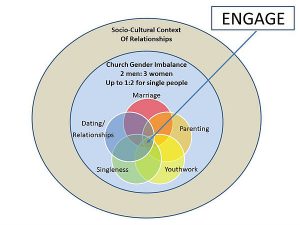 All of this made me very glad to stumble beyond another volume which appear to accept a different focus, just is really engaging with a closely related cluster of issues: seven Reasons Your Church Needs More than Men. I wonder if the title might be discouraging to some, and this is peradventure why it has been independently published by the Engage Network rather than by a regular publisher. But don't permit that put you off; the insights it offers are hinted at in the subtitle: 'How to pb a gender counterbalanced church building supporting healthy singleness, dating, marriage and youth' and this range of interests is illustrated by the diagram on the right from the Appoint home page.
The book probably demands either an commodity to itself—or perhaps a serial of manufactures—only the introduction past Annabel Clarke articulates a highly relevant and integrated vision:
The Bible values singleness and spousal relationship. Single people are every bit valuable and competent every bit married people. At the aforementioned time, God'southward design from the start has been for marriage to reflect his covenant human relationship with the church building, to be foundational to guild, and to be personal experienced by virtually people.
The book covers a wide range of issues. In that location is a adept theological reflection from Adrian Chatfield on the issues around singleness, wedlock and relationships (though I would always circumspection against always drawing on the Trinity to discuss man customs!); explorations of men'southward ministry and singleness, the latter from the excellent Kate Wharton; and overviews of a wide range of related issues. I was particularly impressed with the reflections on why churches attract more men than women, and what might be done almost that. At that place is a discussion about the generational impact if gender imbalance in the church, though I wondered if more could be said about the relationship betwixt marriage, families and 'biological growth' in mission, which has been of importance historically.
Contrary to what some conservatives merits, marriage is not the gospel. Just it is something to which the gospel speaks powerfully for the sake of man well-beingness and the flourishing of society. At that place is much to do—and much we tin can offer—in helping our culture to recover a positive and healthy view of the married life.
If you lot enjoyed this, do share it on social media, possibly using the buttons on the left. Follow me on Twitter @psephizo.Like my folio on Facebook.
Much of my piece of work is done on a freelance footing. If yous have valued this post, would you consideraltruistic £one.20 a month to support the product of this web log?
If y'all enjoyed this, do share it on social media (Facebook or Twitter) using the buttons on the left. Follow me on Twitter @psephizo. Like my page on Facebook.
Much of my work is washed on a freelance ground. If you have valued this post, you can make a unmarried or repeat donation through PayPal:
Comments policy: Proficient comments that engage with the content of the post, and share in respectful debate, tin can add existent value. Seek offset to understand, then to be understood. Make the well-nigh charitable construal of the views of others and seek to learn from their perspectives. Don't view contend every bit a disharmonize to win; accost the argument rather than tackling the person.
Source: https://www.psephizo.com/life-ministry/does-marriage-make-people-unhappy/
0 Response to "Does marriage make people (un)happy?"
Post a Comment